Lesson 1
- esperanto
- Sep 22, 2021
- 1 min read
Updated: Sep 29, 2021
Alphabet

Look at these 6 different letters Ĉ, Ĝ, Ĥ, Ĵ, Ŝ, Ŭ and forget about these 4 Q, W, X, and Y from the English alphabets.
A, B, C('ts'), Ĉ('ch'), D, E, F, G(as like 'g' in 'god'), Ĝ(as like 'g' in 'general'), H, Ĥ(as like 'ch' in 'loch' ), I( as like 'ee' in 'see'), J(as like 'y' in 'yes'), Ĵ(as like 's' in 'measure'), K, L, M, N, O, P, R, S, Ŝ('sh'), T, U, Ŭ(as like 'w' in 'woman'), V, Z.
Personal pronouns
I - mi You - vi It - ĝi He - li She - ŝi We - ni They - ili
if we add the 'a' letter to personal pronouns it will be possessive adjectives.
Example: mia - my/mine, via - your/yours, ilia - their/theirs
Articles
There is only one definite article 'la';
Example: La brasiko - The cabbage.
There is no article like ( 'a', 'an', 'some')
Example: brasiko - a cabbage, brasikoj - some cabbages
Word endings
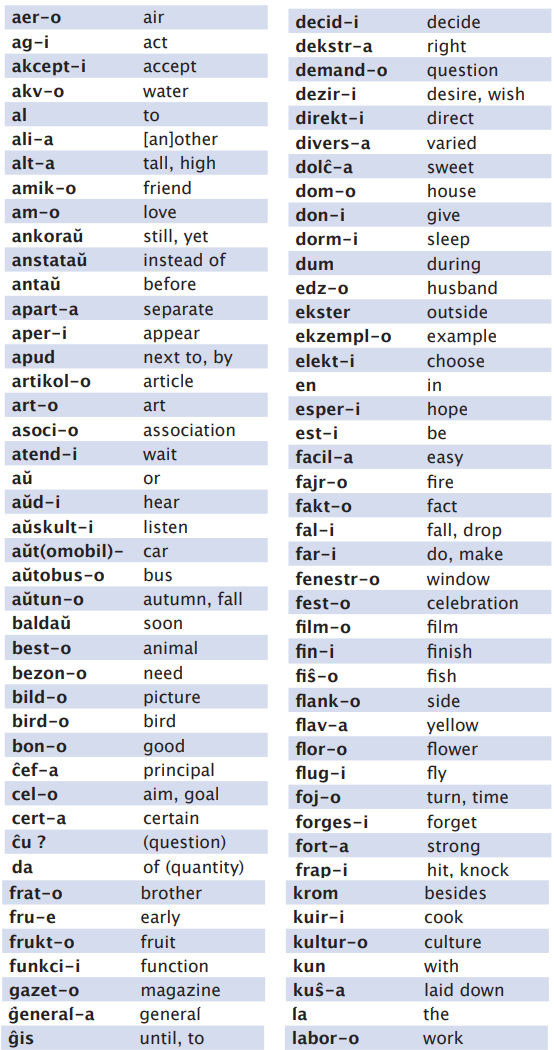
Every noun ends 'o'. Example: aer+o (air), bild+o (picture), bon+o (bird)
Every adjective end in 'a'. Example: ali+a=alia (other), alt+a (tall, high)
Every adverbs end in 'e'. Example: proksin+e (close by), fru+e (early), precip+e (especially)
Every Plural end in 'j'. Example: brasiko+j (cabbages), bono+j (birds), bildo+j (pictures)


Comments